
Burlington, Wisconsin Tree Care You Can Count On: How Rausch Tree & Outdoor Services Protects Your Property Through Every Season
Key Takeaways
- Burlington property owners should take new leaks, broken limbs, trunk cracks, root lifting, and storm damage seriously.
- Professional evaluation can help determine whether a tree needs pruning, health care, monitoring, stump grinding, or removal.
- Rausch Tree & Outdoor Services provides tree care for residential, commercial, rural, and managed properties throughout Southeast Wisconsin.
- Controlled equipment and a written work plan are especially important when trees are close to homes, garages, fences, driveways, or utility lines.
- Healthy trees can add shade, character, and environmental value, but unsafe trees should be addressed before they threaten people or property.
Table of Contents
- Tree Risks Around Burlington
- Evaluating a Problem Tree
- Tree and Outdoor Services
- Storm Response and Emergency Planning
- Long-Term Tree Health
- What to Expect From the Service Process
- Frequently Asked Questions
Burlington, Wisconsin, has a landscape shaped by established neighborhoods, rural parcels, wooded edges, lake-area properties, and the changing weather of Southeast Wisconsin. That variety gives local properties visual appeal, but it also means trees can pose complex safety and maintenance challenges. Rausch Tree & Outdoor Services is a Burlington-based, veteran-owned, and family-operated company that helps property owners assess tree risks and plan practical solutions for their outdoor spaces.
Tree care is not simply about removing anything that looks overgrown. A mature tree may need selective pruning to improve clearance, health-focused care to address stress, or post-storm monitoring. In other cases, decay, root instability, severe structural damage, or proximity to a house can make removal the more responsible choice. The right answer depends on the tree, its condition, and what could be affected if it fails. A certified arborist can inspect the trunk, canopy, and root zone for warning signs such as cracks, fungus, leaning, dead branches, or soil heaving. Early evaluation often reveals low-cost solutions, like cabling, trimming, or improved watering, that preserve a valuable tree. When removal is necessary, planning it before a storm strikes protects your property, family, and nearby neighbors.
Tree Risks Around Burlington
Local trees experience seasonal pressure from heavy snow, ice accumulation, strong winds, saturated spring soil, summer heat, pests, and disease. Freeze-thaw conditions can affect soil around the root system, while high winds may expose a weakness that was not visible from the ground. A tree can still carry leaves and appear generally healthy even when decay, cracks, or root problems are developing inside or below it.
Property owners should consider an inspection when they notice dead or hanging limbs, a sudden lean, cracked bark, hollow areas, fungal growth near the base, exposed roots, lifted soil, or branches extending over roofs and driveways. The target beneath the tree also shapes risk. A compromised limb in an open field presents a different concern than one above a child’s play area, parked vehicle, roof, or walkway. Monitoring Southeast Wisconsin weather alerts can help Burlington residents prepare for conditions that may worsen existing tree defects.
When a dead, leaning, storm-damaged, or poorly located tree needs a closer look, property owners can explore options for tree removal in Burlington, WI, before choosing a course of action. A professional assessment helps clarify the project scope, access limitations, cleanup needs, and whether removal is appropriate.
How a Problem Tree Is Evaluated
A thoughtful inspection starts with the tree’s overall condition and location. Rausch Tree & Outdoor Services can evaluate visible canopy decline, deadwood, trunk defects, decay indicators, root-zone concerns, nearby buildings, equipment access, and areas that could be affected during the work. This site-specific approach is useful on compact Burlington lots as well as farms, commercial grounds, and larger wooded properties.
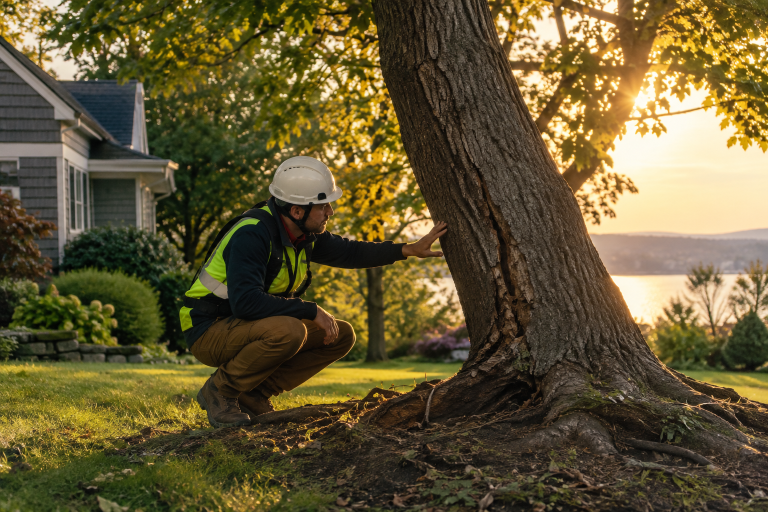
Not every issue requires removing a tree. Pruning may improve clearance or reduce the weight of selected limbs, helping a healthy tree stay strong through storms and heavy snow. A stressed tree may benefit from plant health recommendations, fertilization, or observation over time, since some problems improve once drought, soil compaction, or pests are addressed. When structural defects or advanced decline create an unacceptable risk, removal may be recommended instead. Signs include deep cracks, fungal growth at the base, extensive deadwood, or a noticeable lean. The goal is to give the property owner useful information, rather than treating removal as the automatic answer. A certified arborist can explain each option, outline costs and tradeoffs, and help you choose the safest and most practical path forward.
Tree and Outdoor Services for Burlington Properties
Rausch Tree & Outdoor Services offers a range of services that can be matched to the needs of a particular site:
- Tree removal: For dead, hazardous, severely damaged, or unsuitable trees where preservation is not practical.
- Tree trimming and structural pruning: For overextended limbs, clearance concerns, weak branch attachments, and canopy management.
- Emergency tree service: For fallen trees, blocked access, dangerous hanging limbs, and storm-related hazards.
- Stump grinding: For stumps that interfere with mowing, landscaping, access, or planned improvements.
- Plant health care: For concerns involving insects, disease, soil conditions, root zones, and declining vigor.
- Land clearing and debris removal: For brush, unwanted trees, stumps, and site preparation on residential, rural, or construction-related properties.
Large-tree work requires more than a chainsaw and a clear afternoon. Trees located near garages, fencing, landscaping, neighboring homes, or narrow driveways often require controlled dismantling. The company states that it uses equipment such as spider lifts, cranes, rigging systems, and hauling equipment to improve access, manage sections of a tree during removal, and complete site cleanup. Equipment supports a safer plan, but trained decision-making and careful job preparation remain essential.
Storm Response and Emergency Planning
After a storm, the priority is avoiding additional danger. Keep people and pets away from fallen trees, cracked limbs, and unstable root plates. Never approach a tree that is touching or appears to be touching a power line. If it is safe, take photographs of visible damage before cleanup begins, especially when a structure, vehicle, fence, or driveway has been affected.
Rausch Tree & Outdoor Services provides emergency tree service for situations involving blocked access, trees on structures, and hazardous storm debris. A written estimate and job documentation can also be useful when a property owner needs to communicate with an insurance carrier. Coverage varies by policy and situation, so homeowners should confirm claim details with their insurer rather than assuming every removal will be covered.
Burlington neighborhoods with older shade trees often face a higher chance of storm damage because mature canopies can hold significant weight and spread over roofs, power service drops, and detached garages. Keeping a list of trees that have shown past failure, lean, or heavy limb loss can help owners share useful information during an assessment and prioritize inspections before the next severe weather event.
Long-Term Tree Health Matters in Burlington
Tree work is often most effective when it is proactive. Timely pruning, inspections, root-zone awareness, and attention to pests or disease can help property owners preserve trees that remain sound and suitable for their location. Construction activity, compacted soil, drought, excess moisture, and mechanical damage can all affect a tree long before obvious canopy decline appears.
Healthy urban trees can contribute shade, stormwater management, air-quality benefits, habitat, and neighborhood character. The Wisconsin Department of Natural Resources’ urban tree benefits outline why preserving a structurally sound tree can be valuable. Still, preservation must be balanced with safety. A tree with severe decay, major cracks, or unstable roots may no longer be an appropriate candidate for long-term retention.
Burlington’s freeze-thaw cycles, wet spring seasons, and occasional summer droughts can stress trees in different ways from one year to the next. Property owners with trees near lake-area homes, drainage ditches, or low spots may notice saturated soil that weakens anchorage. In contrast, trees on exposed rural parcels can be more vulnerable to wind-driven limb failure. Reviewing these local patterns each season gives owners a practical head start on maintenance before problems become emergencies.
What to Expect From the Service Process
- Request an estimate: Contact the company to describe the concern and arrange a site visit.
- Complete a site assessment: The crew reviews the tree, hazards, access, equipment needs, and desired outcome.
- Receive a written proposal: The property owner can review the recommended scope of work before scheduling.
- Schedule the service: Timing is coordinated around weather, access, urgency, and the nature of the project.
- Perform the work and cleanup: The agreed-upon service is complete, with debris handling per the project plan.
- Discuss next steps: Stump grinding, monitoring, pruning, or further plant health care may be considered as appropriate.
Location: Rausch Tree and Outdoor Services | 29037 Bushnell Rd, Burlington, WI 53105 | (262) 800-4471
Frequently Asked Questions
How do I know whether a tree should be removed?
Dead limbs, major trunk cracks, visible decay, root damage, a new lean, and storm-related breakage are all reasons to seek a professional assessment. Removal may be appropriate when a tree’s condition and location create a substantial risk.
Can pruning help instead of removal?
Often, yes. Pruning may improve roof or driveway clearance, remove deadwood, reduce the weight of selected branches, and improve the structure. It is not a solution for every defect, particularly when the trunk or root system is severely compromised.
Why should a stump be ground after removal?
Stump grinding can make the area easier to mow, landscape, or reuse. It also removes a visible obstruction and potential tripping point from the yard.

